
Stationary device “GetDew Base”

Humidity and temperature measurement at high process temperatures – special applications for which the stationary humidity measuring device GetDew Base was developed. Relative and absolute humidity are measured exactly where it matters most – directly through continuous, unadulterated sampling from the process, even at very high temperatures – environmental conditions such as those commonly found in baking processes, drying plants, autoclaves and continuous furnaces, or exhaust gas measurement.
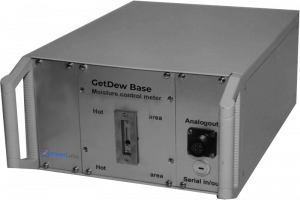
Areas of application for the GetDew Base include industrial furnaces, drying systems and engine test benches. Thanks to its short response time, the GetDew Base also detects rapid changes in the process. It can be integrated into a humidity control system to record the controlled variable.

Special designs are available for additional requirements, such as additional temperature sensors or other types of sensors, for example for measuring flow velocity.

Various options are also available when selecting the interface for connection to the controller. The standard for the digital output is the MQTT protocol and for the analogue output a 4..20mA interface.

GetDew Base

Measurement application

The GetDew Base is designed for continuous operation. To prevent the humidity sensor from becoming dirty too quickly, the air must be pre-filtered. These filters must be replaced when they become dirty. If the air is heavily contaminated, it may also be necessary to clean the sensor at regular intervals. The frequency of these maintenance intervals depends on the process. It can range from days to weeks.

The air to be analysed must be fed to the measuring device through a heated hose. This is necessary to prevent moisture from condensing on cold surfaces before it is analysed in the measuring device. Air is transported through the device by a pump that is either already built into the device or can be provided by the user.

With seven additional external temperature sensors (optional), temperature distributions can be measured. By using very small sensors, the surface and internal temperatures of a process material can also be measured.

Operation and visualisation

The connection to the device is established via a USB-C interface. The user interface can be accessed via standard web browsers. All the tools required to operate the device are available on the website. Recorded measurements can be displayed and exported in common formats (ods, xls, csv, xml, json). The USB-C interface works with a virtual network card to integrate the device into the local network. The data is made available to the network via an MQTT publisher.

At the same time, the dew point temperature is available analogously via a 4..20mA (or 0..20mA adjustable) interface. (or 0..20mA, adjustable). The measurement range of the air humidity, which is mapped to 4..20mA, is also adjustable. Digital outputs indicate whether the device is measuring and whether the measured values are plausible.

Measurement principle

Moisture sensor: The GetDew Base works according to the dew point principle. The surface of an electric stray field capacitance is cooled until dew condenses on it. The temperature of the surface at this moment is a direct measure of the absolute humidity (grams of water per cubic metre of air). Since this method reduces humidity measurement to a pure temperature measurement, the sensor technology achieves a high degree of measurement accuracy and dynamics. Even rapid changes in humidity in the range of 1°C to 100°C dew point can be detected without any problems.

The adjacent graph shows that a change in humidity from 17°C to 88°C dew point temperature is registered in just under 10 seconds. Such a change, equivalent to approximately 14g of water per cubic metre of air to 396 g/m³, occurs, for example, in the humidification zones of continuous ovens.

Diagram: Dynamics of the measuring principle


Temperature sensors: The GetDew Base can optionally be used with NiCr-Ni thermocouples, type K. The temperature measuring range is between -100°C and 500°C. Other ranges can be offered as an option. Up to seven temperature sensors can be connected as an option; more are possible on request. All inputs are galvanically isolated from the measuring device and from each other. This prevents electrical interference between the sensors. Thermocouples have a very small mass and can therefore accurately measure the internal temperature of small objects. In a flat design, they can be used to measure surface temperatures.

Other transducers: Additional transducer types can also be offered as options, for example for voltage or current inputs, resistance temperature sensors (Pt100) or anemometers.

Technical specifications

max. air inlet temperature:350° Celsius
dew point temperature:
(the minimum achievable dew point temperature is approx. 50 Kelvin below the intake duct temperature)
1° C – 100° C
external temperature sensors (optional):max. 7 NiCr-Ni thermocouples type K
measurement range of external temperature sensors:-100° – +500°C (other ranges on request)
storage temperature:-10° C – +45°C
relative error of external temperature sensors:± 0.5%
relative error of dew point temperature:± 1%
dew point dynamics:max. 8 Kelvin/s
measurement frequency of all measuring points:max. 10Hz (10 measuring points per second)
interface:USB-C
power supply:230V, 150W
dimensions (L*W*H):140 x 235 x 350 mm³
housing:19″, 3U / 42HP / D 305 with handle, white
weight:approx. 5 kg

brief description

Highly dynamic humidity and temperature measurement at high process temperatures according to the dew point principle with stray field capacitance,
Analogue output of humidity values via an analogue current interface (0(4)..20mA),
Digital output of all measured values via MQTT,
Device readiness indicator via digital outputs,
Optional up to 7 temperature measuring points for connecting external thermocouples,
Communication via USB-C interface,
Optional up to 7 temperature measuring points for connecting external thermocouples,
Transducers for other physical quantities available as an option,
Device operation, reading and saving data via web browser,
Export data using common data formats.
Scroll to Top