Applications and industries

On the following page, we would like to describe a few selected measurement problems. You will see that the use of modern measurement technology can save a lot of personnel costs in development and production.

With the help of our measuring instruments and services, many large European bakeries have been able to gain important insights into baking and drying processes and eliminate errors in the production process.

However, measuring humidity and temperature is also very important in many other industries, such as testing technology in the automotive industry. We have listed some of these industries at the end.
Comparative measurement of biscuits baked in two different ovens

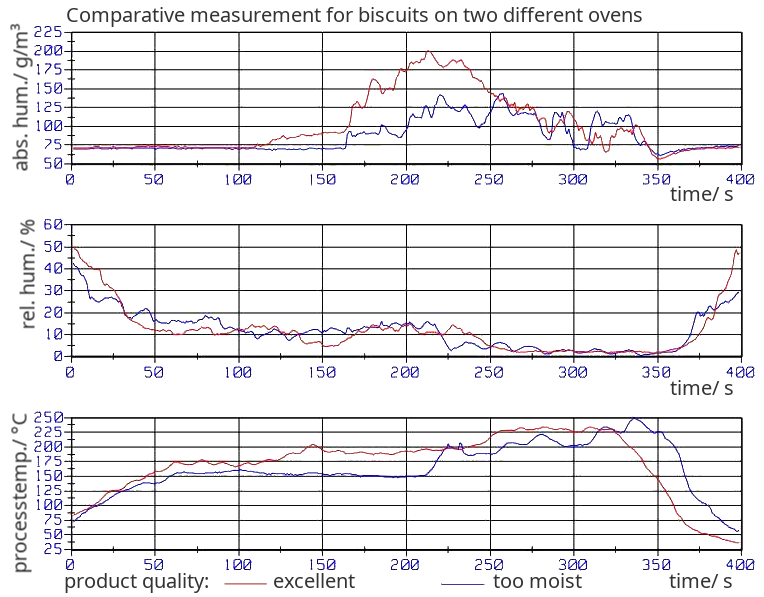
Two products with identical recipes, baked on different ovens, left the process with different browning characteristics and residual moisture. Attempts to increase the temperature in the first section of the moist line were unsuccessful. A measurement of all parameters, including air humidity, was intended to determine the cause of the error.

The comparative measurement on both ovens shows significant differences in absolute humidity. Since the product is not steamed, all moisture from the process must have escaped from the baked goods.

In line 1 (red graph), the air humidity is significantly higher in the range from 120s to 250s than in line 2 (blue graph) in the same section. A look at the temperature curves shows that line 1 is heated much more strongly (temperature difference of up to 50K).

As a result, the product temperature in line 2 cannot rise as quickly, the boiling point of the water is reached later and the air humidity in line 2 cannot be as high as in line 1. The result in line 2 is an end product with higher material moisture than in line 1.

After this comparative measurement and the correct interpretation of the data, it was possible to synchronise the ovens.

Diagram biscuit comparative measurement

Comparative measurements for protein-based baked goods in a deck oven

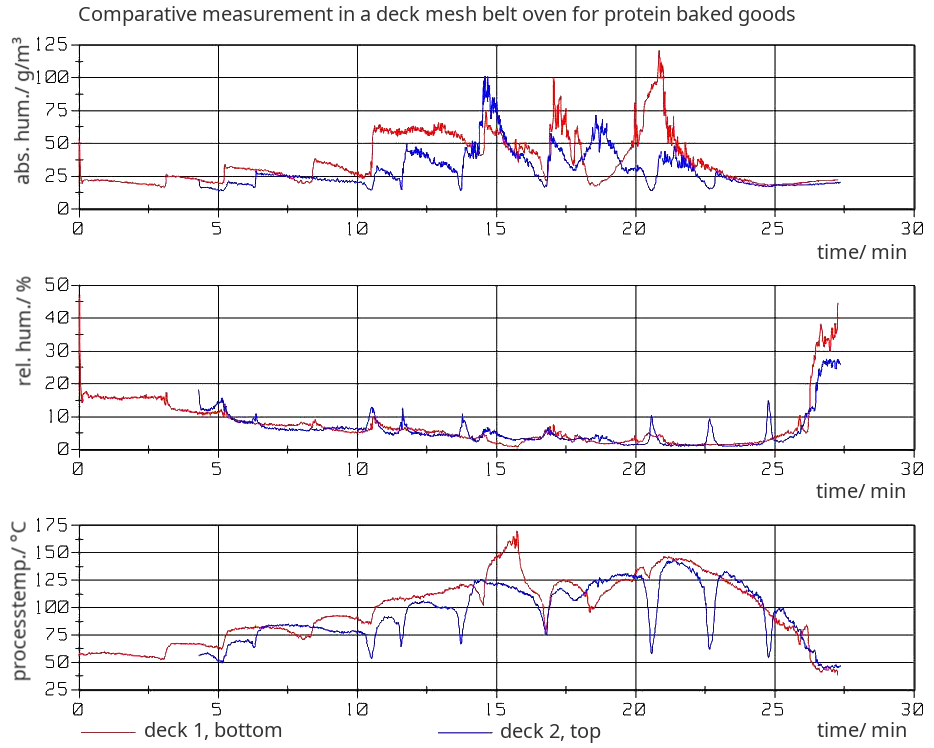
Diagram of protein biscuits in a deck oven

During otherwise flawless production of protein-based baked goods on a deck oven, sudden significant differences in quality arose between products baked on different decks.

A comparative measurement on both belts was intended to provide information about the causes. To this end, one measurement was taken on the lower belt and one on the upper belt. The absolute humidity in g/m³ shows completely different values, especially in the ranges from 10 to 15 and 18 to 23 minutes.

By measuring directly in the furnaces at product height, the fault could be narrowed down to the furnace atmosphere. Uneven draft conditions were adjusted and partially open furnace doors were closed. After these measures were taken, both products could once again be produced with identical and very good quality. The recurring drops in humidity and temperature on belt 2 at 6, 11, 12, 14, 17, 21 and 22.5 minutes were due to open inspection hatches.

Roll baking process with steam injection

In a medium-sized company in the baking industry, bread rolls are produced in a continuous oven. Daily throughput is approximately 1 million pieces in three-shift operation. After increasing the oven throughput, it was found that the surface quality of the baked goods no longer had the required shine. It was suspected that the steam supply was no longer sufficient.

After a lengthy experimental phase, the company decided to measure the oven parameters.

The air humidity and seven temperatures were measured across the width of the oven. In order to obtain a height profile of the moisture distribution, three measurements were taken at different distances from the baked goods. It was found that the humidity in the first zone, particularly at product height, remained well below the physically maximum possible level – an explanation for the insufficient shine on the product surface.

Since the steam generator was already operating at its performance limit, there was no leeway here. However, with knowledge of the moisture profile, the solution was to make the steam extraction adjustable and optimise it to such an extent that the steam was better distributed in the first oven zone. This increased the overall moisture in this zone, which in turn led to a significant improvement in product quality.

The measurements took approximately two days. The subsequent corrections took just as long.

We have estimated and compared the costs for you, both with and without measurement support.

If you believe that option 2 is the better choice, please feel free to contact us.

Comparing costs with and without using SensorLabs humidity measuring service

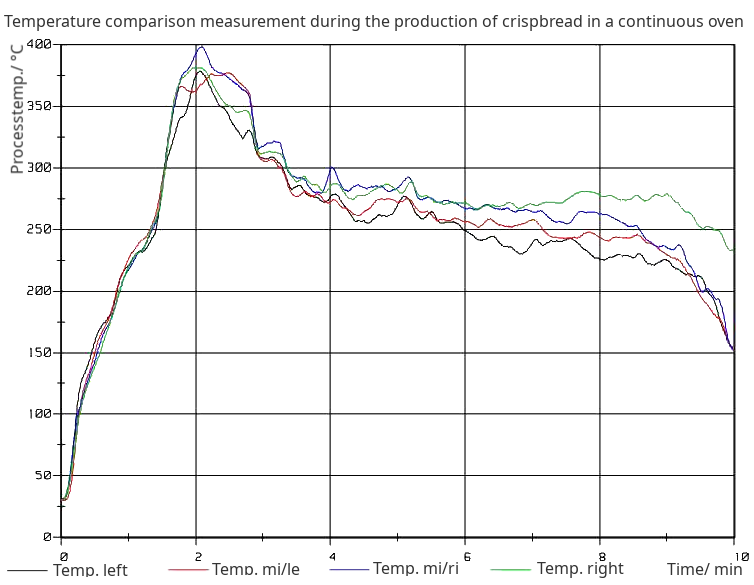
Temperature comparison measurement across the width of the oven for crispbread

Diagram: Comparative measurement of crispbread

In addition to the humidity sensor, our measuring devices also have seven external temperature inputs, whose sensors can be arranged almost anywhere in the process chamber. This enables temperature comparison measurements across the width of the oven.
 
In a plant for the production of crispbread, an oven that was incorrectly adjusted across its width was suspected due to differences in product browning. The exact locations of the temperature asymmetries needed to be determined.
 
The following graph shows the results, which were also confirmed by the different product qualities. A quick measurement allowed the location of the temperature error to be determined and the cause of the error to be eliminated.

Dynamics of our measuring principle

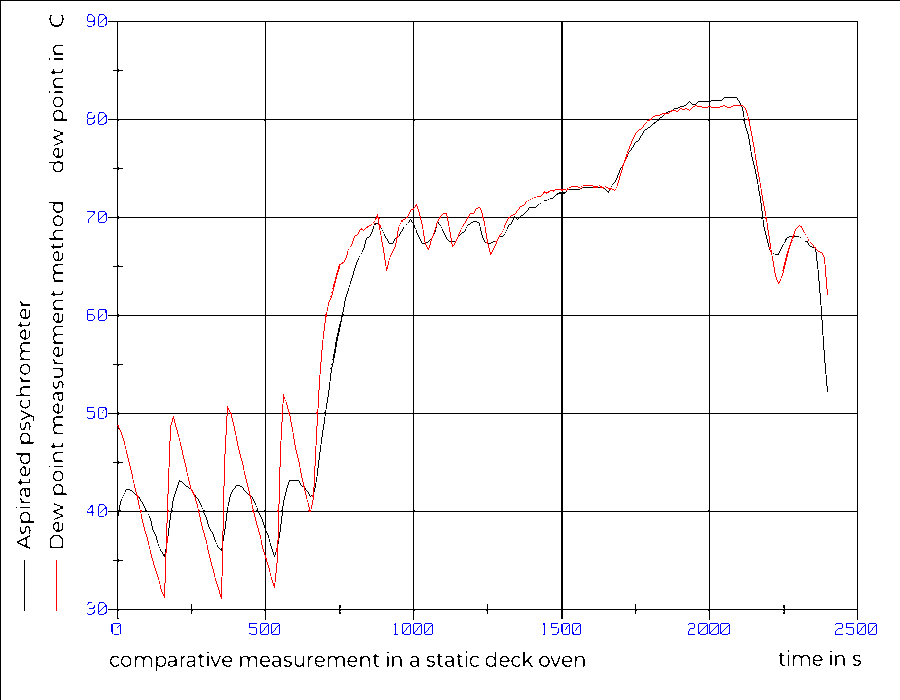
In order to test the high dynamics required of our measuring principle in continuous systems, an experiment was conducted at the former TNO Nutrition, a research institute of the Dutch bakery industry in Zeist, Netherlands, in which the device was exposed to several moisture jumps during the baking process. A stationary device operating on the impact jet principle was used as a comparison device. According to the manufacturer’s specifications, this device had a t90 time constant of 80 seconds (explanation: after 80 seconds, the device used there displayed 90% of a moisture jump). Such a measuring method would be too slow for dynamic processes.

The graph shows the significantly steeper curve of the dew point measurement method used by SensorLabs in response to changes in humidity.

Particularly in the period up to approximately 600 seconds, humidity fluctuations are not fully registered by the reference device, as the high time constant of the sensor results in averaging.

Diagram: Dynamic comparison measurement

Industries with processes up to ~500°C, where temperature and humidity play a role

IndustryTypical applicationsRelevance of temp./humidity
Food industry / bakeriesBaking ovens, deck ovens, tunnel ovens (e.g., bread, cookies)Yes, for baking result, crust formation, moisture loss
Pharmaceutical industryDrying, sterilization, granulate processingYes, for stability and active ingredient behavior
Ceramics and porcelain industryPre-firing, drying of clay and glazesYes, because humidity causes stresses or cracks
Automotive industryDew point determination in exhaust gasYes, because excessive humidity can condense in the downstream measurement chain
Plastics processingDrying prior to extrusion/injection molding (e.g., PET, PA)Yes, low residual moisture is essential
Electrical engineering / electronics manufacturingReflow soldering, drying of PCBsYes, moisture leads to microcracks, “popcorning”
Paint and coating industryBake coating, powder coatingYes, for drying conditions and adhesion
Textile and nonwoven processingThermobonding, hot air bondingYes, ambient humidity affects strength and fibers
Pulp and paper industryDrying cylinders, calendering cylindersYes, moisture content determines paper quality
Wood processingDrying of sawn timberYes, highly moisture-sensitive; deformation possible
Chemical industryDrying, catalysis, reaction temperature controlYes, often strongly temperature- and humidity-dependent
Building materials industry (e.g., gypsum, cement)Drying, curing, calcinationYes, ambient humidity affects curing and final quality
Tobacco processingDrying and conditioningYes, humidity is critical for flavor & deformation

Have you found yourself here again?

Please feel free to contact us.

Scroll to Top